- Start with the city overview and a practical pre-trip checklist
- Understand when to use the subway, JR and Nishitetsu
- Book accommodation first; plan day trips in the middle, Tenjin shopping later and finish in Hakata.

Attractions, food and transport at a glance
FUKUOKA FREE TRAVEL GUIDE · 2026 Attractions, food and transport at a glance FUKUOKA FREE TRAVEL GUIDE · 2026 Fukuoka Travel Guide Fukuoka is unusually easy to navigate: the airport is close to the center, while Hakata and Tenjin make practical bases for food, shopping and day trips. This guide covers preparation, transport, accommodation, attractions, food, Kyushu extensions and sample itineraries.
How to use this guide
Learn the transport systems, choose a base, then treat each attraction guide as a half-day or full-day building block.
Fukuoka basics for first-time visitors
Planning your first tripa Fukuoka trip,:Fukuoka,,。、,。
Expand guide
Hakata is the main JR, Shinkansen and bus hub. Tenjin is the center of department stores, underground shopping and nightlife, while Nakasu is known for its riverfront and yatai food stalls.
For a first trip, explore the Hakata–Nakasu–Tenjin core, then choose one direction per day: Dazaifu, Yanagawa, Itoshima, Kokura or Mojiko.
Five areas to understand
Hakata
Best for airport access, JR trains, the Shinkansen and last-day shopping.
Tenjin
Department stores, underground malls, restaurants and a strong rainy-day option.
Nakasu
River views, yatai and nightlife; light sleepers may prefer a nearby district.
Western Fukuoka
Ohori Park, the castle ruins and Fukuoka Tower for a slower day.
Day trips
Dazaifu, Yanagawa, Itoshima and Kitakyushu—one direction per day.
Common planning mistakes
- Trying to combine Dazaifu, Itoshima and Mojiko in one day.
- Checking only holidays at home and missing Japan's Golden Week, Obon or major events.
- Assuming the International Terminal has direct subway access; the station is at the Domestic Terminal.
- Losing hours to a famous restaurant queue when a good alternative is nearby.
- Buying a rail pass before writing the actual route.
- Forgetting that Fukuoka City accommodation tax may be collected at check-in.
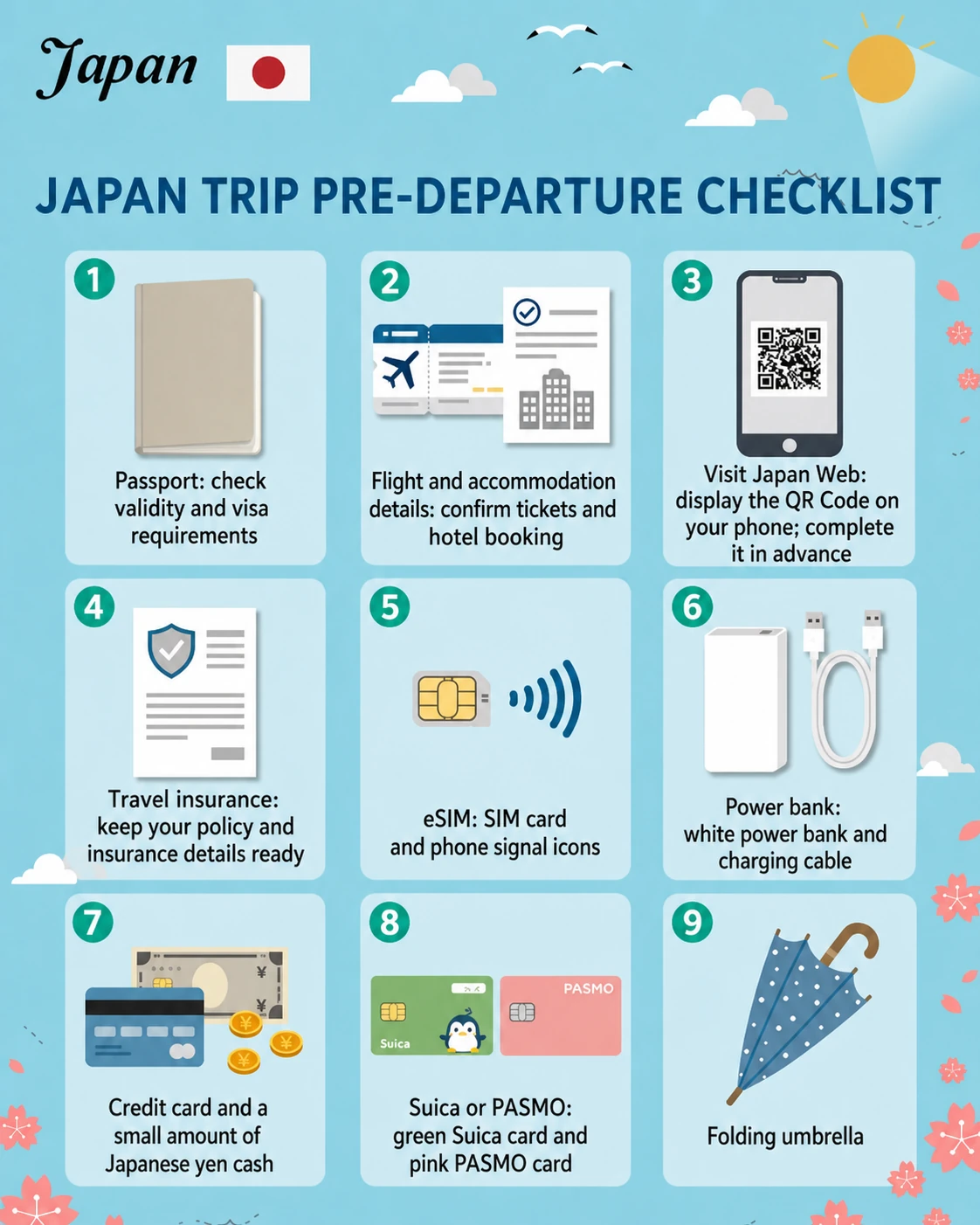
Before you go
Documents
Check your passport, flights, accommodation and the entry rules that apply to you. Visit Japan Web can be completed before arrival.
Connectivity
Choose an eSIM, SIM or Wi-Fi. Japan uses 100V power; check your own plug and charger compatibility.
Money
A card plus some yen is the safest mix. Some stalls, small shops and lockers may not support every payment method.
Packing
Bring comfortable shoes, a light layer and a compact umbrella; the waterfront and air-conditioned trains can feel cooler than expected.
Sort out your internet before departure for the easiest experience. Click to load recommended plans (prices and availability are based on the sales page). Navigation, store searches, and translations in Okinawa will use data.
If the widget does not appear, you can open it directly: Japan eSIM Plan
Official resources to save
- Visit Japan Web
- JNTO Fukuoka information
- Fukuoka Airport
- Fukuoka City Subway
- JR Kyushu
- Japan Meteorological Agency
Useful apps and transit IC cards
- Google Maps for walking routes, station exits and dispersed Itoshima stops.
- Japan Travel by NAVITIME for JR, limited express and Shinkansen planning.
- Google Translate for menus and basic communication; download Japanese offline first.
- Suica, PASMO and ICOCA work on the subway, many JR routes and at convenience stores. Supported iPhones can add a card to Apple Wallet. Support on other phones depends on model, region and FeliCa/Osaifu-Keitai compatibility; buy a physical card if unsure.
Apple Wallet transit card instructions
How to budget
Airfares vary too much by departure city, baggage and season to use one home currency as a universal estimate. Build the ground budget in yen—accommodation, meals, local transport and day trips—then add the live fare from your own city, including baggage.
When to visit
| When to visit | A compact city with easy day trips |
|---|---|
| Spring, Mar–May | Mild days and cool evenings; good for Dazaifu and city walks. |
| Summer, Jun–Aug | Hot and humid with rainy-season and typhoon risks; use sun protection in Itoshima. |
| Autumn, Sep–Nov | Usually the easiest season for walking and day trips. |
| Winter, Dec–Feb | Cool and sometimes windy; ideal for hot pot and indoor shopping. |
2026 tax updates
Baggage reminders
- Power banks and spare lithium batteries must not go in checked baggage; follow your airline's capacity rules.
- Meat products and fresh fruit face strict import controls.
- Keep receipts and allow extra departure time if customs confirmation or a refund is required.
Fukuoka transport explained
Fukuoka rail travel is manageable, butthere is more than one system:「Fukuoka」,「JR 」「()」。,。
Expand guide
Use the city subway for central Fukuoka, JR Kyushu for Kitakyushu, Yufuin and longer journeys, and Nishitetsu for Dazaifu and Yanagawa. They are separate systems, so exiting and re-entering at a transfer is normal.
| Fukuoka transport explained | Subway, JR and Nishitetsu |
|---|---|
| Fukuoka City Subway | Airport, Hakata, Nakasu-Kawabata, Tenjin and Ohori Park |
| JR Kyushu | Kokura, Mojiko, Yufuin, Kumamoto and Shinkansen journeys |
| Nishitetsu | Dazaifu, Yanagawa and southwestern Fukuoka |
Airport to the city
The subway station is beneath the Domestic Terminal. Most international visitors arrive at the separate International Terminal and take the free inter-terminal bus before boarding the Airport Line. Allow extra time during busy periods or with large luggage.
Choosing a day trip
- Dazaifu — Nishitetsu to Dazaifu Station for the shrine and approach street.
- Yanagawa — Nishitetsu from Fukuoka (Tenjin) to Nishitetsu-Yanagawa for a canal cruise and eel meal.
- Kokura and Mojiko — JR north for a castle town, market and retro port day.
- Itoshima — Subway/JR Chikuhi Line reaches parts of the coast, but a car or taxi is more flexible.
- Yufuin — A limited express from Hakata takes a little over two hours; reserve popular services and consider staying overnight.
Which ticket to use
- Short city rides: use a transit IC card.
- Many subway rides in one day: compare the subway day pass.
- Dazaifu or Yanagawa: price the actual Nishitetsu route before choosing a bundle.
- Multiple intercity trains: list each fare before deciding whether a JR Kyushu Rail Pass pays off.
Rail or rental car?
Rail is easiest for Hakata, Tenjin, Nakasu, Dazaifu and Yanagawa. A car becomes useful for Itoshima's scattered coast and cafés. I normally use rail in the city and rent only for the Itoshima day; never plan to drive after drinking.
Where to stay in Fukuoka
Where you stay largely shapes your evenings. My usual approach is:book weekends and holiday dates first(、 CP),Hakata——;Tenjin。the middle of the trip,I strongly recommend Hakata for the final night,。
Expand guide
Your base shapes every evening. My habit is to book expensive holiday nights first, use Hakata for convenience and choose Tenjin when shopping is the priority. Hakata is particularly practical for the final night.
Hakata Station
The easiest airport, JR, Shinkansen and bus connections.
Tenjin
Department stores, underground malls and a reliable rainy-day plan.
Nakasu
Immediate riverfront and yatai atmosphere; choose elsewhere if noise matters.
Kokura
Stay one night if Kokura and Mojiko need two relaxed days.
Things to do in Fukuoka
Use each guide as an itinerary block. Pick one full-day guide or combine two half-day routes in the same direction. Give outlying destinations their own day.
Kushida Shrine and Kawabata
Shrine culture, shopping arcade, Canal City and local snacks.
Read the full guideShopping, food and nightlife
Underground malls, department stores, river walks and yatai.
Read the full guideOhori Park, castle and tower
Park walks, historic remains, sunset and skyline views.
Read the full guideDazaifu day trip
The shrine, approach street and local sweets.
Read the full guideItoshima coast drive
Sea views, cafés and seafood; a car offers the most freedom.
Read the full guideCanal cruise and eel rice
A waterways cruise, Okinohata walk and local cuisine.
Read the full guideMojiko Retro
Historic port buildings, strait views and baked curry.
Read the full guideKokura Castle and Tanga Market
Castle-town history, a market and Kitakyushu food.
Read the full guideYufuin travel guide
Lake Kinrin, Yunotsubo Street and an onsen stay.
Read the full guide15 places to eat in Yufuin
Bungo beef, sweets, cafés and walking snacks.
Read the full guideRainy-day, family and seaside options
Use Tenjin's underground malls, Hakata Station or BOSS E・ZO on wet days. Families can pair Uminonakamichi Seaside Park with Marine World. Nokonoshima is a relaxed half-day or full-day sea escape without a long drive.
Fukuoka food guides
The practical approach is one specialty each evening: motsunabe, tonkotsu ramen, yatai, mizutaki, yakitori or yakiniku. Use the topic guides below.
15 popular motsunabe restaurants
Fukuoka's signature offal hot pot.
Read the full guide20 Hakata and Tenjin ramen shops
Compare broth styles, noodle firmness and queues.
Read the full guide10 Fukuoka food stalls
Where to try the city's open-air stall culture.
Read the full guide20 Fukuoka yakiniku picks
From affordable lunch to wagyu dinner.
Read the full guide8 unagi restaurants
City and Yanagawa-style eel meals.
Read the full guideHakata and Tenjin yakitori
Chicken-skin skewers and casual evening dining.
Read the full guide9 Fukuoka sukiyaki choices
Wagyu and traditional hot-pot dining.
Read the full guide15 Tenjin and Nakasu bars
Cocktails, views and nightlife districts.
Read the full guidePrivate dining in Fukuoka
Options for groups, families and quieter meals.
Read the full guideShopping and souvenirs
Use Tenjin for fashion, cosmetics and electronics; Hakata Station for transport and souvenirs; Canal City for mixed entertainment; and LaLaport for families and the life-size Gundam.
Hakata Station
AMU Plaza, Hankyu, food halls and easy airport access.
Tenjin
Underground malls connect department stores and drugstores.
Canal City Hakata
Shopping, restaurants, fountain shows and the Ramen Stadium.
LaLaport Fukuoka
The large Gundam, shops and a food court.
- Mentaiko sauces, crackers and gift boxes
- Hakata Torimon and Hiyoko sweets
- Amaou strawberry confectionery
- Ichiran and Ippudo ramen gift packs
Exploring Kyushu from Fukuoka
Hakata Station is the gateway to the Kyushu Shinkansen and JR services.Use Fukuoka as a base or first stop,(Yufuin/)、、、。,Fukuoka。Planning:Fukuoka,。
Expand guide
Hakata is a major Shinkansen and limited-express hub. On a short trip, combine the city with one day trip; with five nights or more, consider Kumamoto, Nagasaki, Beppu or Kagoshima.
Yufuin
Yufuin is the classic onsen extension. The limited express from Hakata takes a little over two hours and popular trains should be reserved. Stay overnight for Lake Kinrin and Yunotsubo Street without rushing.
Read the full guide · Read the full guide
Oita
Yufuin and Beppu for onsen and geothermal sights.
Kumamoto
The castle is easy by Shinkansen; Aso needs separate transport planning.
Nagasaki
A port city of slopes, churches and night views.
Kagoshima
Better for trips of five nights or longer.
How many days in Fukuoka?
Planninga Fukuoka trip: → Hakata/Tenjin → 1~2 (~)。Hakata;/Yufuinthe middle of the trip,Tenjin、Hakata。
Expand guide
Book a base in Hakata or Tenjin and limit each day to one or two same-direction blocks. My order is central Fukuoka first, day trips in the middle, Tenjin shopping late and Hakata on departure day.
2 days|City only
- Day 1: Kushida, Kawabata, Canal City and a Nakasu dinner.
- Day 2: Hakata souvenirs; add Tenjin if the flight is late.
3 days|City plus one day trip
- Day 1: Hakata, Kushida, Kawabata and Nakasu.
- Day 2: Choose Dazaifu, Yanagawa or Itoshima.
- Day 3: Tenjin or Ohori, then Hakata and the airport.
4 days|Two directions
- Day 1: Hakata and Nakasu.
- Days 2–3: Choose two from Dazaifu, Yanagawa, Itoshima or Kokura–Mojiko.
- Day 4: Tenjin, Hakata souvenirs and airport.
5 days|Fukuoka and Yufuin
- Day 1: Hakata and Nakasu.
- Days 2–3: Overnight in Yufuin.
- Day 4: Tenjin after returning.
- Day 5: Hakata and airport.
6–7 days|Small Kyushu loop
- Fukuoka 1–2 nights → Yufuin or another prefecture 2–3 nights → final night in Hakata.
- Store or forward large luggage instead of moving it daily.
Fukuoka travel FAQ
Expand guide
Where should a first-time visitor stay?
Choose Hakata for transport or Tenjin for shopping. Stay in Nakasu only if nightlife outweighs possible noise.
Is the airport far from downtown?
No. Domestic arrivals connect directly to the subway; international arrivals normally use the free terminal bus first.
What should I eat first?
Try motsunabe, Hakata tonkotsu ramen and a yatai, then add mentaiko, mizutaki, yakitori or eel.
Dazaifu, Yanagawa or Itoshima?
Dazaifu for shrine culture, Yanagawa for a cruise and eel, Itoshima for coast, cafés and seafood.
Can Yufuin be a day trip?
Yes, but it is rushed. An overnight stay is much better when time and budget allow.
Do I need a rail pass?
Usually not for the city. Start with an IC card and compare passes only against your real route.
Can I visit during Japanese holidays?
Yes, but book hotels and popular trains early and reduce the daily schedule.
When should I schedule day trips and shopping?
I put day trips in the middle, Tenjin on the penultimate day and Hakata souvenirs on departure day.
Uminonakamichi, Nokonoshima or teamLab?
Choose Uminonakamichi for a family day, Nokonoshima for a relaxed sea escape, and teamLab/E・ZO for rain or evening.
When should I buy souvenirs?
I normally shop in Tenjin on the penultimate day and finish at Hakata Station before the airport.