
- First understand the heart of the city and what to bring before traveling
- Distinguish how to enter Yamanote Line, subway and airport
- Book a hotel first. Stay on the same side every day (eg east side Ueno + Asakusa). Each scenic spot article takes about half a day to a day; if you go far in the middle, you can go shopping in department stores if it rains.
Attractions × Food × Transportation Complete Guide
The difficulty in Tokyo is not that there is nothing to do, butToo big, too little information. This page starts with how to describe the city, preparation before departure, railways and airports, and then connects to the attractions in each area of the station and food guide. When arranging days, I have a habit: walk to a farther area in the middle, put shopping later (also as a rainy day), and stay on the route to pick up souvenirs from the airport on the last day.
1. Tokyo Basics & Trip Prep
Tokyo Basics & First-Time Travel Tips
It will be much easier if you first accept that "you won't be able to finish the whole day" when you come here for the first time. Shinjuku, Shibuya, Ikebukuro, Ueno, and Tokyo Station are formed into circles respectively, and the circles are connected by railways.
How Tokyo Is Laid Out
The city is dense and has too many choices. You can go to the shrine Omotesando at Asakusa, then go to a department store and a crossroads after a few stops; in the evening, go back to the accommodation station for a meal and call it a day. The point isStay in the same direction on the same day, less turning back; it doesn’t matter if the list is endless.
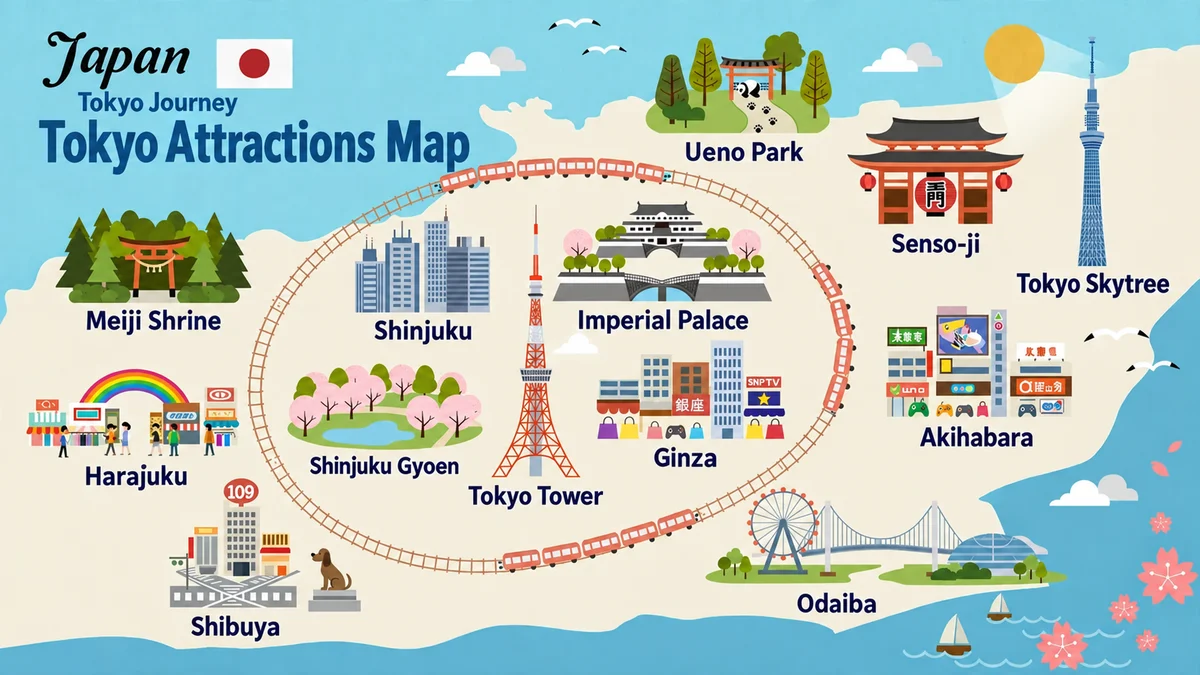
Start With Tokyo’s Main Areas
There is no single "city center" in Tokyo, more likeSeveral people are obsessed with Yamanote Line. First understand what each circle is about, and then decide where to live and which side to walk on during the day. Scroll down for detailed attractions Block Picks。
Shinjuku
A super-large terminal + high-rise buildings + department stores, with an exaggerated number of exits, but it is also one of the tightest circles for accommodation, pharmacies, and nighttime eating and drinking. next doorShin-OkuboIt is Koreatown, where Korean food and beauty products are concentrated. It can be found on the same day as Shinjuku. Shinjuku guide
Shibuya
The intersection is adjacent to the shopping mall, and major renovations have continued in recent years. High density of youth culture, brand stores, and nightlife;Shibuya Sky For this kind of observatory, you need to book a time slot first, don’t bet on the spot. Shibuya・Harajuku guide
Harajuku・Omotesando
The axis of fashion and street sense: Takeshita Street, brand flagships, and beautiful coffee shops are all on this line. Suitable for shopping and taking photos, the same fan shape as Shibuya is the most smooth, don't cut it to Asakusa. Shibuya・Harajuku guide
Ikebukuro
Sunshine City has a concentration of anime and character shops, as well as an aquarium and viewing area. Yamanote Line is a large station on the north side. It is very practical as a place to stay; you don’t have to travel halfway across Tokyo to find food at night. Ikebukuro guide
Asakusa
Classic sightseeing towns: Asakusa Temple, Nakamise, and time-honored restaurants with strong Edo flavor and crowds. Suitable for walking slowly during the day; besideKuramaeFocusing on coffee and groceries, the pace is relatively slow. Asakusa guide
Ueno
Zoo, art gallery, park walk; next to the stationAmeyokoEat, drink and shop. It is more reasonable to go to the same "east side fan" row as Asakusa and Yane Sen on the same day than to go on the same day as Shibuya. Ueno guide Gu Genqian guide
Tokyo Station・Marunouchi・Nihonbashi
The station itself is a check-in point; there are souvenirs inside the station, the Marunouchi office district has a beautiful street view, and Nihonbashi has a sense of history with its old shops and bridges. Suitable for arrival day, departure day, or half a day without rushing. Tokyo Station guide Nihonbashi guide
Ginza
High-end department stores and brand avenues, traditional old stores and trendy stores coexist. The store density is high and the distance is long; it can be connected to Tokyo Station, Hibiya, or combined with Tsukiji. Ginza guide Tsukiji guide
Odaiba・Toyosu
Odaiba is the Wangan entertainment area (Rainbow Bridge, Gundam, shopping mall); Toyosu is the market and emerging food and shopping, teamLab Planets is also on this side. Different from Yamanote Line inner ring movement, usuallyHalf day to one day tripGo. Odaiba・Toyosu guide
Roppongi & Azabudai
International nightlife and Hills Shopping Mall; Azabutai Hills + teamLab Unbounded has become a hot topic landmark in recent years. It can be combined with the Tokyo Tower direction for one day, and tickets must be booked in advance. Roppongi & Azabudai guide
- How to use Yamanote Line: Like a circular trunk line, a large station is mostly a living circle. Living in a subway station that is online or has direct access to these major stations will save a lot of mental energy.
- The principle of arranging heaven: Stay on the same side on the same day (for example, Ueno + Asakusa on the east side, or Shibuya + Harajuku on the west side). As you can see on the map in the morning and evening in the east, your feet will be exhausted.
- Airport traffic: South of Haneda, east of Narita; for the last day’s accommodation and souvenirs, it’s best to be close to the route you want to take on your return trip.


Illustration: Stay in the same "sector" throughout the day and avoid going back.
Tokyo Weather: Recent Summers Run Hot
You don’t need to take all of these. If you know you have tickets first, you will not regret not waiting in line when you arrive at the venue.
- Azabutai Hills × teamLab Unbounded:Roppongi is a new landmark in the area. If you want to see teamLab, you must first book timed-entry tickets before departure. The tickets are often sold out on site. Online booking
- Warner Bros. Studio Tour Tokyo: In Nerima Ward, some distance from the city. Movie fans need to spend at least 4 to 5 hours watching the movie; tickets are divided into different shows, and they must be booked first and then queued up. Online booking
- DisneySea "Fantasy Springs": The queues for facilities such as Frozen are fierce. If you want to rush, you should queue up at the gate before the park opens and pay for quick customs clearance before entering the park. It is more practical than thinking about strategies after arriving on site. Online booking
- Shibuya Sky, Skytree: The dusk session at the observatory is often sold instantly. If you want the sunset, book a time slot on the platform in advance, don’t bet on the spot. Online booking Online booking
- Ghibli Art Museum: No tickets are sold on site, fixed rules are to grab every other month’s tickets. If you can't get it, don't force it on. Change it to the Fujiko Fujio Museum or the city. If released:Check tickets online
- Yomiuriland’s Pokémon theme park: Tickets are in high demand during popular periods; fans can queue up and skip the general itinerary, saving a day for urban areas or suburbs.

Common First-Timer Mistakes
- Traveling across three sub-cities in one day: Asakusa in the morning, Shibuya in the afternoon, and Ikebukuro in the evening. As you can see on the map, both feet will be reimbursed.
- Fill up on shopping first: Carrying large and small bags when walking or rushing to an exhibition will be very annoying. Put shopping, medicine and cosmetics at the back, and the luggage is relatively small.
- ignore rainy days: Tokyo will change if it says so. Department stores, underground shopping malls, and train stations form a shopping mall, which is suitable for filing. There is no need to follow the outdoor list.
- The queue is too far on the last day: On the day of departure, it is safer to reserve souvenirs in an area that is easy to pick up at the airport than to go to a spot that is "far away but wants to go".
- Checking only holidays at home and overlooking Japan’s holiday periods: During Golden Week (around early May), Obon (around mid-August), cherry blossom and maple viewing season, housing prices and crowds are fierce. If you can stagger it, stagger it; if you hit it, lock the room first and relax your schedule.
- Carrying large luggage on the Peak Tram: Approximately 7:30–9:00, 17:30–19:30 Yamanote Line, the central line is very crowded. Dragging a 29-inch onto a tram would be a pain, and it would easily get in the way of people. During this period, it is better to leave later or store your luggage first.
- Use queues at famous stores as the main axis: Wudijia, Liulishe, Toyosu famous stores, it is common to wait for 1 to 2 hours. Just keep one or two popular restaurants, and for the rest, look for the food articles on the site to register, so don’t spend the whole day waiting in line.
- Use the big station as a maze to force your way through: The exports of Shinjuku, Tokyo, and Shibuya are exaggerated. Before leaving the station, check the exit name given by the hotel. If you get lost, ask the station staff; above-ground landmarks are sometimes easier to understand than underground ones.
- The tax refund time is too tight: The system and on-site movement routes will be changed (including subsequent adjustments related to unified airport tax refund). If there is a lot of shopping, take an extra 1 to 2 hours to go through the formalities. Don’t use the “last bus is stuck” schedule.
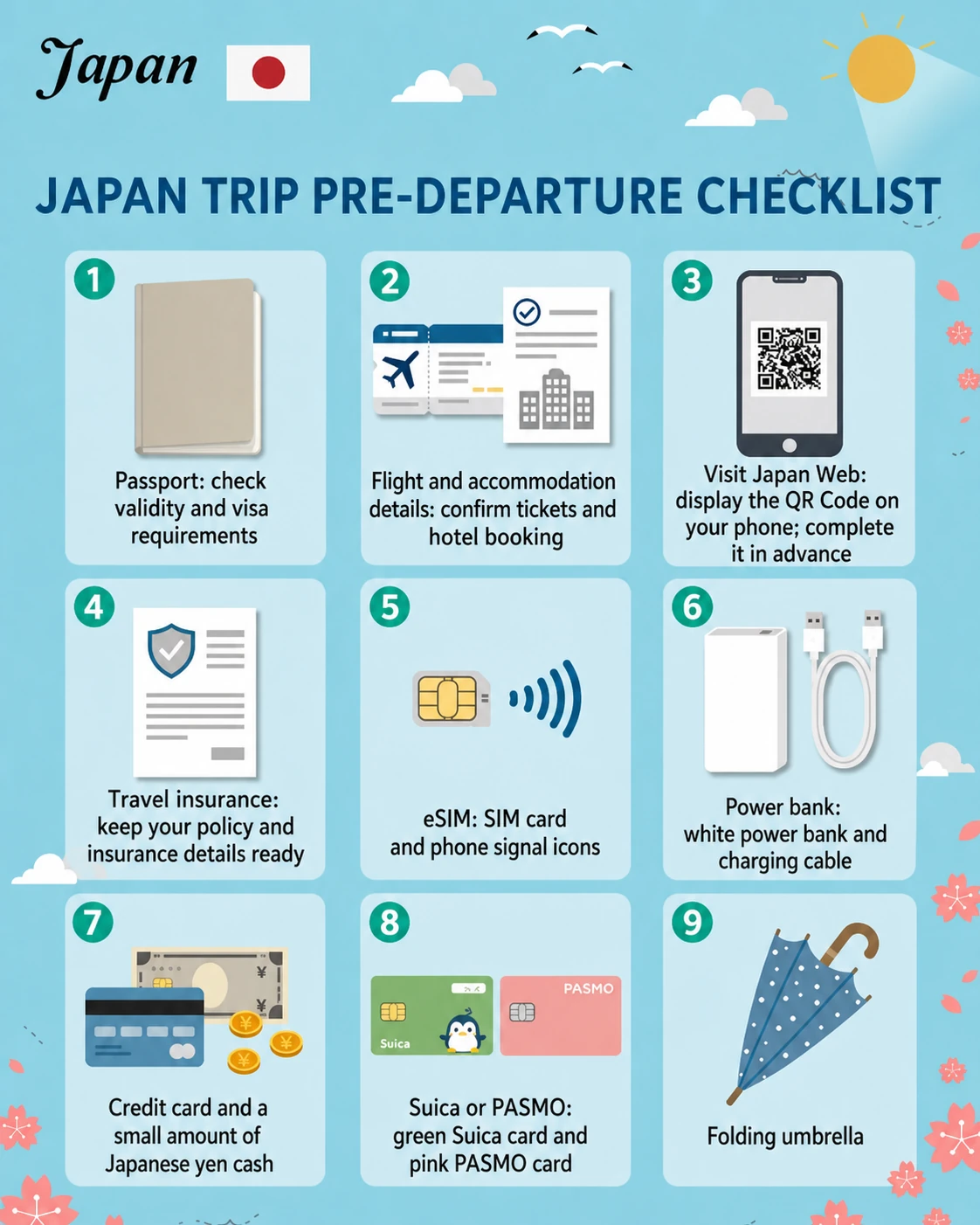
Pre-departure checklist
Documents and entry
- Passport validity, air tickets and accommodation information
- It is recommended to complete it beforehand Visit Japan Web(Subject to official regulations)
- Travel inconvenience insurance (luggage, medical)
Internet and electricity
- eSIM/network card/Wi‑Fi choose one
- Japan 100V, most most modern USB chargers can be used directly
- Mobile power supply: useful for transferring trains and queuing up
money and payments
- Credit card + small amount of cash (small shop, restaurant, coin locker)
- Mobile phone Suica/PASMO can be tied up first
- PayPay etc. are useful, but don’t use them as your only payment method
Luggage and clothing
- Good walking shoes: 10,000 steps a day is common
- Jackets that can be put on and taken off in layers: there is a big temperature difference between the car and the outdoors
- Folding umbrella: Afternoon thunderstorms are not news
From November 2026: Japan’s Tax-Free Shopping Changes
If the itinerary falls in After November 2026, Japan's shopping tax refund process is different from before. I read the new system once before departure, so I don't panic at the airport. Under the old system, when you spend 5,000 yen or more and show your passport at checkout, you can get an on-the-spot tax discount;From November 1, 2026, "on-site tax refund" will be completely stopped., changed toTax first, tax later: Pay the tax-included price first when shopping, and then go to the airport to apply for a tax refund when leaving the country to get the tax back.
- Checkout: Pay the tax-included amount first; use the amount provided by the store J-TaxRefund Website/QR Code to register passport and payment method (credit card, bank account or cash, etc., subject to on-site selection).
- Departure: Go to the airport self-service check-in machine (KIOSK) or customs counter to complete the inspection and confirm that you are eligible for tax exemption. The refund will be transferred to the designated account.
- time: There will probably be longer queues for tax refund at the airport. It is recommended to reserve plenty of time compared to the old system to avoid being stuck on boarding the plane.
Details and updates are subject to the official/site version; if you want to understand the process at once, you can read:Introduction to Japan’s New Tax Refund System。
Packing and Restricted-Item Reminders
Check "what you can bring/cannot check/cannot enter" before departure. It is more cost-effective than being stopped or having your things thrown away at the airport.
- Power bank and lithium battery: According to civil aviation regulationsNot allowed to be checked, must be carried on board the aircraft. Capacity Below 100Wh(approximately 27,000mAh) can probably be placed directly in hand luggage;100–160Wh Prior approval from the airline is required, with a maximum of two pills per person;More than 160Wh prohibited. Some airlines will require you to discard mobile power banks of unknown brands and without marked capacity. Please make sure the specifications are clearly marked before departure. Small items with built-in lithium batteries, such as electric razors and wireless earphone charging cases, are also recommended.Take it with you, to avoid being stopped by your consignment.
- Food entry (Japanese customs is very strict): Fresh fruits andAll meat products are prohibited, including meat buns, dried meat, ham, instant noodles containing meat, etc. Violators may face heavy fines. Specialties containing water (such as peanut tofu, sea grapes, jelly, etc.) are mostly liquid/semi-liquid, so remember to addconsignmentrather than hand-held (if subject to the 100ml liquid rule, aviation/security inspection shall prevail).
- Stand-alone gadgets: It is recommended to keep cold medicine, gastrointestinal medicine, analgesics and OK bandages with you. Most Japanese supermarkets have to pay for shopping bags, so it is very practical to bring a lightweight environmentally friendly bag; you can also bring a thermos bottle, which is convenient for rehydration when going out.
Adding Suica or ICOCA to Your Phone
Most people in Japan use transportation ICs when taking rides or making small payments at supermarkets. If you can bind it to your mobile phone, you need to bring one less card; if you can't bind it, just buy a physical card. Commonly used in Tokyo area Suica/PASMO, commonly used in Kansai ICOCA. Most of the time, you can brush each other across regions.Issuance and recharge interfaceIt still depends on the card type.
- Suica (including Apple wallet, etc.): Most iPhones can be added in "Wallet"; see the steps and precautions. Suica mobile phone binding tutorial. many Android phones sold outside Japan is often unable to use official digital Suica, so buy a physical card or check the currently available solutions.
- ICOCA + Apple Pay: When departing from Kansai or if you already need ICOCA, you can follow ICOCA Apple Pay Tutorial operation. Device/system versions and regional restrictions are subject to teaching and official guidance.
- Practical reminder: Before departure, try to see if you can add a card or store value (credit card/cash recharge machine); if your phone is out of battery, you can’t use it, so you can prepare a physical card or cash on the day. The balance can be used as small payment at supermarkets and some vending machines.
Tokyo Weather & What to Wear by Season
The following are the common ranges in Tokyo city (approximately, there are differences from year to year); in the morning and evening and at the seaside/highland, it is ±3–5°C, and fine-tuning can be done based on the forecast one week before departure.
| season | Average temperature by month (approximately) | Dressing recommendations |
|---|---|---|
| spring March–May |
March Average temperature is about 10°C (minimum is about 5°C/maximum is about 15°C) April Average temperature is about 15°C (minimum is about 10°C/maximum is about 20°C) May Average temperature is about 20°C (minimum is about 15°C/maximum is about 25°C) |
Early spring (March): Thin sweater, light jacket or windbreaker, paired with pants or skirt. High spring (April): Denim jacket or light windbreaker, layered with a long-sleeved T-shirt or shirt. Late spring (May): Lightweight long-sleeved or short-sleeved tops, paired with pants or skirts. |
| summer June–August |
June Average temperature is about 23°C (minimum is about 20°C/maximum is about 26°C) July Average temperature is about 27°C (minimum is about 23°C/maximum is about 31°C) August Average temperature is about 28°C (minimum is about 24°C/maximum is about 32°C) |
Early summer (June): Light long-sleeved or short-sleeved, bring a light jacket to cope with rainy season and temperature changes. Midsummer (July–August): Short sleeves, shorts or skirts; pay attention to sun protection and bring rain gear, which is mainly light and cool. |
| Autumn September–November |
September Average temperature is about 23°C (minimum is about 20°C/maximum is about 27°C) October Average temperature is about 17°C (minimum is about 13°C/maximum is about 22°C) November Average temperature is about 12°C (minimum is about 7°C/maximum is about 17°C) |
Early autumn (September): Long-sleeved shirt or thin sweater, paired with a light jacket and trousers. High autumn (October): Knitted sweater, jacket + trousers or skirt; there is a big temperature difference between morning and evening, so be sure to keep warm. Late autumn (November): Thicker sweaters, jackets, warm pants or skirts are recommended. |
| winter December–February |
December Average temperature is about 7°C (minimum is about 3°C/maximum is about 11°C) January Average temperature is about 5°C (minimum is about 1°C/maximum is about 9°C) February Average temperature is about 6°C (minimum is about 2°C/maximum is about 10°C) |
Early winter (December): Thick sweater, warm jacket (wool coat or light down). Severe winter (January–February): Down, sweater, scarf and gloves; cold-proof trousers or skirt (thick socks/pantyhose can be used). |
Official Travel and Entry Websites
The following are official or semi-official entrances. The link will be changed and the site will prevail. Spend 15 minutes before departure and the airport is less stressful.
- Visit Japan Web: Official web service for entry inspection and customs declaration. It is recommended to register and fill it out before taking off. It will be easier to show the QR at the airport. See explanation Introduction to Digital Hall。
- Japan National Tourism Organization JNTO (Traditional Chinese): Seasonal activities, traffic overview, safety reminders, suitable as a general directory.
- JNTO Japanese/multilingual portal:Official tourist information center.
- airport:Haneda Airport | Narita Airport(Flights, transportation, and facilities are subject to the official website)
- Orbit:JR East (Traditional Chinese) | Tokyo Metro | Toei Transportation
- Meteorology:Japan Meteorological Agency(This is more accurate than the community during typhoons and heavy rains).
Useful Apps for a Japan Trip
No need to fully dress up. I always have: map, translation, traffic search, payment/IC. The iOS/Android link is attached below. The store page is based on your device region.
Visit Japan Web
You can do it with a browser, not an app. Official website:vjw.digital.go.jp. Filling it in before landing is the most stable.
Google Maps
It’s enough for walking, subway, and store hours. You can download offline maps for backup.
App Store |
Google Play
Japan Travel by NAVITIME
Shinkansen, private railways, and subway transfers are tourist-friendly and sometimes more detailed than just looking at Google.
App Store |
Google Play
Google Translate
The camera shooting menu and conversation mode are both commonly used; the offline language pack can be loaded with Japanese first.
App Store |
Google Play
Suica/PASMO (mobile phone)
Most iPhones can add Suica/PASMO to "Wallet". Many Android phones sold outside Japan often cannot use digital cards, so you can just buy a physical card instead. The balance can be used as a small payment.
GO(タクシー)/Uber
Use the app to call when traffic is difficult to stop during rush hour. GO taxis are common in Japan; Uber is also available in some areas.
GO · App Store |
Uber · Play
eSIM/Airline App
The network needs to be fixed first (eSIM or network card). Watching the airline app push for flight changes is more accurate than just watching the airport screen.
Yahoo! Japan Transit Planner
Transfer queries commonly used by locals; the interface is in Japanese, so you can cross-reference when Google gets weird. Just search "in the transfer case" in the store.
How Much Does a Tokyo Trip Cost?
Numbers are just "magnitudes". During peak seasons, eating big meals, and buying more park tickets will jump up. 5 days and 4 nights, equally divided double rooms in a general business hotel, including a Disney class ticket (see hot ticket coupons It is recommended to order a list first), many people fall intoroughly US$1,000–1,350 per person(Including air tickets); during the cherry blossom season or Chinese New Year, air tickets and accommodation may be more expensive. Thinking about accommodation and food multiplied by 8 days is more useful than rote memorization of tables.
- air tickets: Low-cost airlines have the opportunity to charge lower prices during the off-season; after adding checked baggage, it is often similar to traditional airlines, and the baggage fee is included before checkout.
- Matsuyama—Haneda: Tickets are often a little more expensive, but the time to enter the city is short, and sometimes it’s a good deal for people who live in the north and have a lot of luggage.
- shopping: For drugstores and electrical appliances, check out Don Quijote, Matsumoto Kiyoshi, Sundrug, Bic, etc.; download store coupons if they are available, and calculate the general ledger after tax exemption and full discounts can be used together. Tokyo Station can be purchased as a souvenir or at the airport, so it doesn’t have to be carried while playing.
For information on store coupons and tax exemptions, see:Japan Discount/Coupon Lazy Pack。
2. Trains & Airport Access
Tokyo Trains and Airport Access
There are many tracks in Tokyo, but beginners only need to divide them into three levels:JR (including Yamanote Line)、Tokyo Metro/Toei Subway, andAirport Express into the city. A basic base on mobile transportation IC is more practical than researching travel passes from the beginning.

JR, Tokyo Metro and Toei Subway: What’s the Difference?
| system | when you will use it | How to remember |
|---|---|---|
| JR Yamanote Line etc. | Between major stations, moving in a circle, connected to many private railways | It is commonly used in "Futeto Tokishima" |
| Metro/Toei | Drill into each area and pass through the inside of Yamanote Line in a straight line | "Go into alleys and take shortcuts." |
| Airport express | Narita N'EX/Skyliner; Haneda Keikyu/Monorail, etc. | "Save transfers for large luggage" |
Yamanote Line: Start With the Loop
Yamanote Line is like Tokyo's outer ring road, Shinjuku, Shibuya, Ikebukuro, Ueno, Tokyo, and Shinagawa are all on it. Try to stay on the same daysame sector: For example, Ueno-Asakusa should be used for one day, and Shinjuku should be used for one day. Do not cut in the morning and in the evening.
- Short range, multi-purpose across sites Suica/PASMO(Mobile phones are the easiest to use), and you can also use them at convenience stores.
- There are many Metro/Toei stations on the same day, and then calculate whether the 24/48/72-hour subway ticket is worth the money (Tokyo Metro Official)。
- JR and subway often have toExit and enter again, the IC will buckle separately, this is normal.
Illustration: The two airports have different directions into Tokyo.
Getting Into Tokyo: Haneda vs Narita

The two airports have different directions into Tokyo:South of Haneda, close to most urban areas;Narita is east, be sure to choose the right car. Next, create an impression first, and then use "where to stay" to map it to specific trains and buses.
Closer to Central Tokyo
Keikyu (often via Shinagawa) or Tokyo Monorail (Hamamatsu-cho). The area around Shinshinagawa, Shimbashi, Ginza, and Asakusa usually takes less time than Narita; see the Haneda section below for details.
Choose the Right Narita Train for Your Hotel Area
Skyliner→Nippori/Ueno (east side of Sumita Town);N'EX→Tokyo/Shinjuku/Ikebukuro/Shibuya/Shinagawa, etc. (Stay at Yamanote Line Main Station). Large baggage priority express. Skyliner KKday Skyliner N'EX KKday N'EX
Direct Airport Limousine Bus
It’s great if you have a lot of luggage, you have children, or if there are stops at hotels or Disney; it takes longer than express trains, so you’re afraid of traffic jams. Airport Limousine Bus KKday Limousin
Subway interactive map
After entering the city, you can transfer to:Tokyo Metro interactive map. Write down the itinerary before buying tickets. Don’t preset one ticket to conquer the world.
Narita Airport: Choose N'EX or Skyliner Based on Your Hotel
Narita in TokyoRemote on the east side, you can’t just take a bus into the city. The terminal stations are different, so you can stay in the right circleLess changing cars and less luggage. The two most commonly used express trains are:
Skyliner (Nippori/Ueno)
The end point isNippori, Uenoarea. liveUeno, Asakusa, Tanesen, Akihabara Eastward, Keisei Ueno peripheralsAlmost the first choice is to walk or take one subway stop to the hotel after arriving at the station. The carriages have a large luggage space, the flights are fixed, and the time is easy to grasp. Order Skyliner KKday Skyliner
Narita Express(N'EX)
Take JR to reachTokyo Station, Shinagawa, Shibuya, Shinjuku, IkebukuroWait (according to the day's flight/grouping, check the ticket to arrive at the station). liveShinjuku, Ikebukuro, Shibuya, Tokyo Station, ShinagawaWhen traveling, N'EX is often more trouble-free than "get to Ueno first, then carry your luggage and change to Yamanote Line". Check/Order N'EX KKday N'EX
Hotel Area → Best Route From Narita
| The circle you live in | preferred | Why choose this |
|---|---|---|
| Ueno/Asakusa/Nippori/Tanisen | Skyliner → Ueno or Nippori | It is almost directly connected to Shitamachi on the east side; after arriving at Ueno, transfer to Asakusa and then transfer to Metro or bus, which is very close. Don't go to Shinjuku first and then turn back to the east. |
| Akihabara/Kanda/Ochanomizu | Skyliner Ueno re-conversion, or N'EX Tokyo Station re-conversion | Look at your luggage: If you have a lot of luggage, you can take a short trip from N'EX to Tokyo Station; a light Skyliner + one subway trip will do. |
| Tokyo Station/Marunouchi/Nihonbashi/Ginza | N'EX → Tokyo Station | Exit the station at the city center gateway; Ginza, Nihonbashi and then Metro or walk. From Skyliner to Ueno, it takes a while. |
| Shinjuku/Okubo | N'EX → Shinjuku | One bus to the Shinjuku station circle, suitable for hotels near the West Exit/South Exit. People who use Skyliner have to switch to Yamanote Line to carry luggage, which is more tiring. |
| Ikebukuro | N'EX → Ikebukuro(See the schedule) or N'EX Shinjuku/Tokyo Zai Yamanote Line | N'EX flights that are direct to or closer to the destination are preferred; confirm the stops on the ticket. The Skyliner route is too easterly and not cost-effective. |
| Shibuya/Harajuku/Omotesando | N'EX → Shibuya(When there is a stop) or transfer to N'EX Shinjuku/Shinagawa | The N'EX stops at that day shall prevail; if there is no direct connection, choose the nearest major station to your accommodation and then take a short tram. |
| Shinagawa/Tamachi/Hamamatsucho south side | N'EX → Shinagawa, or check if it flies firstHanedacloser | Accommodation in the south is usually more friendly to Haneda; if it's Narita, N'EX Shinagawa is often better than going around Ueno. |
| Odaiba/Toyosu/Ariaki and Disney peripherals | See firstAirport Limousine Bus; Orbit will be rotated after N'EX | There are many bus transfers between Wangan and the park, and if you have a lot of luggage, the bus directly to the hotel/park is less likely to crash. |
When the Airport Limousine Bus Makes Sense
When you have a lot of luggage, elders and children, Limousin is often better than trams.More suitable for novices and large luggage, not just slower filings. Both Narita and Haneda have routes to major hotel areas, Tokyo Station, Shinjuku, Disney, etc. (flights and stops are subject to the official website/ticket sales).
- Super suitable: A lot of luggage (28-29 inches + loot), taking care of elders and children, living inThere are stops in front of hotels or nearby in Limousin, want to goDisney/WanganI don’t want to change cars two or three times.
- Be mentally prepared: time normallyLonger than an express train, traffic jams will become longer during rush hours, rainy days, and accidents. Reserve a buffer and don’t use a schedule that “just happens to be stuck on your flight.”
- How to use: Check the route/hotel name at the airport bus boarding counter; some tickets can be purchased online in advance. When you arrive at the station, you usually get off at a hotel or transfer station, and there is less hell on the subway to haul luggage.
- How to choose between Express and Express?: If you stay in Ueno, Shinjuku, etc. "the express terminal is very close" → the trams are often more stable; if you stay in a hotel with direct bus access, or if there are many people and luggage → Limousine is more relaxed. Airport Limousine Bus Ticket KKday Limousin
Haneda Airport: Pick the Route That Matches Your Hotel
Haneda is heresouth side, it usually takes less time to get to Shinagawa, Shimbashi, Asakusa, and Ginza than Narita. Two common ones:
Keikyu Line (Haneda Airport → Shinagawa, etc.)
toShinagawaGet started quickly, then transfer Yamanote Line to Shinjuku, Shibuya, Tokyo Station, etc. If you live in Shinagawa, Takanawa, or Tamachi, or if you want to connect to Yamanote Line station, Keikyu is very commonly used. For some flights, you can take the Toei Asakusa line to Sengakuji Temple.AsakusaDirections (confirm the transfer first if you have a lot of luggage).
Tokyo Monorail (→ Hamamatsucho)
ArriveHamamatsuchoTake JR and go in the direction of Tokyo Station, Ueno or Yamanote Line. Suitable for those staying near Hamamatsucho/Damon, or if you are more familiar with JR transfer. Just choose one main route with Keikyu, and study the other two until the night before departure.
Haneda Limousine
The same applies to "If you have a lot of luggage, go directly to the hotel". The distance from Haneda to the city is shorter, and traffic jams often take longer than express trains, but it saves energy. Chalimuzin KKday Limousin
Haneda vs Narita (how to remember)
Haneda: Close, many choices, most urban areas, 30–60 points.Narita: Far away, be sure to choose the right express terminal or bus, usually 60-100 minutes + queue. It is also recommended for return journeys and departures.The last night was spent on the line with easy access to the airport.。
Airport to Central Tokyo: Quick Comparison
| situation | Recommended | less recommended |
|---|---|---|
| Live at Ueno/Asakusa, enter from Narita | Skyliner | First N'EX go to Shinjuku and then turn back |
| Live at Shinjuku/Ikebukuro, enter from Narita | N'EX (or Limousin directly to the hotel) | Skyliner to Ueno and then drag Yamanote Line |
| Lots of luggage, children and elders | Limousine or express to the main station | The cheapest ordinary car that needs to be replaced 2 to 3 times |
| If you live in Shinagawa/most urban areas, enter from Haneda | Keikyu or monorail | Take a long way around to save some money |
| Go to Disney/Wangan Hotel | Limousine or official suggested route | Blindly enter Yamanote Line and then think of a solution |
If you want to see the steps with pictures and text, you can read: Narita Airport traffic finishing Haneda Airport traffic finishing (Flight fares are subject to on-site/official website).
From airport to hotel: practical sequence
Taking "getting off the plane → track → accommodation station" as the main axis, it is not easy to panic when taking apart the steps.
- ① Immigration and baggage: Immigration inspection → Baggage collection → Customs. Follow the Arrival indicator.
- ② Choose the urban approach: Let’s look at the accommodation circle first: Narita for Ueno/Asakusa Skyliner, for use with Shinjuku/Ikebukuro/Shibuya/Tokyo Station N'EX;Haneda uses Keikyu/Monorail. If you have a lot of luggage, you can go directly to the hotel. Limousine. Choose less expensive routes that require two or three changes.
- ③ IC or ticket: It’s easiest to have a Suica mobile phone; if you don’t have one, just buy a ticket or apply for a transportation IC at the airport (depending on the counter/machine you visit).
- ④ Arrive at the station and exit the gate: There are many exits in the main station. First, identify the exit names provided by the hotel (East Exit, West Exit, Underground Street Name), and then go to the ground to drag your luggage.
- ⑤ Sense of time: It usually takes about 30-60 minutes from Haneda to most urban areas; it usually takes about 60-100 minutes from Narita to urban areas, plus buffering during rush hours and queues.
Which Tokyo Transport Pass Should You Buy?
Mobile phone Suica/PASMO
Short distances, supermarkets, and vending machines are all convenient, and first priority is given to first-time visitors. iPhones can be tied to wallets; Androids mostly buy physical cards.
1–3 day subway ticket
It’s easier to get back the money if you buy at many Metro/Toei stations on the same day.Check subway tickets online KKday subway ticket
N'EX/Skyliner
Ueno/Asakusa→Skyliner; Shinjuku/Ikebukuro/Shibuya/Tokyo→N'EX. If you have big luggage, you’ll need to change trains less often. Order Skyliner KKday Skyliner Check N'EX KKday N'EX
Keikyu/Monorail
Most urban hotels are closer and have high time flexibility. Lots of luggage to see Airport Limousine Bus KKday Limousin。
Frequently Asked Transport Questions
- Suica/PASMO: Functions are similar, used as Easy Card. Most iPhones can be directly inserted into the wallet; many Android phones sold outside Japan often cannot provide digital cards and require physical cards. Kansai's ICOCA can also be used for transportation and supermarkets in Tokyo. (Official description:JR East Suica)
- Welcome Suica and other tourist editions: Some are deposit-free, have expiration dates, and the balance rules are different from ordinary cards. Read the machine description before buying, don’t treat it as a long-term collection card.
- Airport Limousine Bus: If you have a lot of luggage, it is very convenient to go directly to a hotel or Disney; the time is usually longer than the express, and the traffic jam is more obvious. See the "Airport Limousine Bus" section above for the complete scenario. tickets KKday Limousin
- Chuo Line Express: Tokyo Station ⇔ Shinjuku is faster and often saves time than going around Yamanote Line. Take note of the east-west movement in the urban area.
- Taxi: A bit more expensive than Taipei; it is sometimes cost-effective to share a short trip with 3 to 4 people. It’s hard to stop the peak, so you can use GO or Uber apps to get there without any fuss.
